Phone & SIM Setup guide
China Phone Number, SIM Card, and App Verification Guide
A practical guide to deciding whether foreign visitors need a Chinese phone number, local SIM card, eSIM, or roaming for apps, SMS verification, Wi-Fi, taxis, delivery, and payments.
SIM-card availability, plans, verification rules, and app behavior can change by city, carrier, device, and platform. Official carrier or airport counters should be treated as the operating authority.
Quick answer
Use eSIM or roaming for immediate data, but get a local SIM when SMS verification, local calls, delivery, lockers, or longer stays are important.
Use this practical sequence to prepare, act, and recover if the normal plan does not work:
- Before departure, decide which services you truly need: maps, messaging, payment, ride-hailing, delivery, lockers, hotel calls, or local customer support.
- Use roaming or a travel eSIM for immediate data after landing, especially if you need maps and translation before reaching a SIM counter.
- If you need a mainland number, buy a local SIM from official airport counters, carrier stores, or official airport service stations; bring your passport.
- Confirm whether your phone supports physical SIM, eSIM, dual SIM, and the relevant bands before relying on a local SIM plan.
Applies to foreign visitors deciding between roaming, esim, travel sim, and a mainland chinese phone number, travelers who need ride-hailing, food delivery, lockers, wi-fi login, bank cards, or local app verification, visitors who want a practical decision rule instead of buying every connectivity product before arrival.
Key facts
Before departure, decide which services you truly need: maps, messaging, payment, ride-hailing, delivery, lockers, hotel calls, or local customer support.
Use hotel help, staffed counters, or Alipay/WeChat mini-program alternatives; buy a local SIM if the workflow is essential.
Try passport Wi-Fi login, ask an airport service desk, or use roaming/eSIM as the bridge until the SIM is active.
Check physical SIM support before buying, ask the counter to test data and calls, or use a travel Wi-Fi/roaming fallback.
Phone-number and SIM-card requirements apply across mainland China, with local airport and carrier workflows.
Airports are the easiest place for many visitors to buy a local SIM or get connectivity help after arrival.
Step-by-step plan
- 01
Before departure, decide which services you truly need: maps, messaging, payment, ride-hailing, delivery, lockers, hotel calls, or local customer support.
- 02
Use roaming or a travel eSIM for immediate data after landing, especially if you need maps and translation before reaching a SIM counter.
Official visual reference
Use passport authentication when airport Wi-Fi SMS is not available
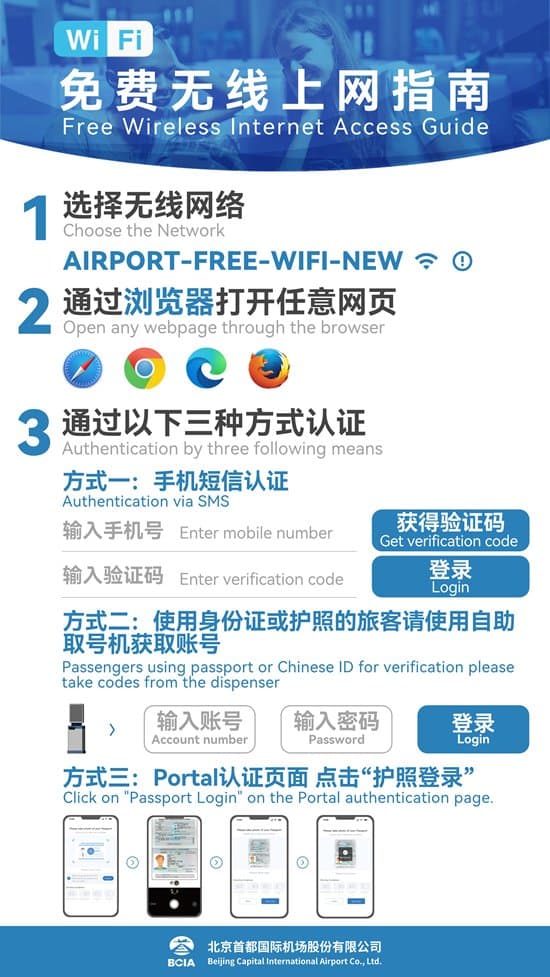
For a foreign number, use the airport's stated passport-authentication option or ask the official service desk. This is a bridge to connectivity, not a reason to share your passport data with an unofficial helper.
Beijing Municipal Government · airport Wi-Fi guideReviewed Jul 12, 2026
- 03
If you need a mainland number, buy a local SIM from official airport counters, carrier stores, or official airport service stations; bring your passport.
Official visual reference
Find an official airport SIM service counter

Use an airport carrier or official service counter and bring your passport. Test data, SMS, and a call before leaving the counter.
Beijing Municipal Government · PKX SIM card application and collectionReviewed Jul 12, 2026
- 04
Confirm whether your phone supports physical SIM, eSIM, dual SIM, and the relevant bands before relying on a local SIM plan.
- 05
After activation, save the phone number in your notes and test SMS, data, and one local call before leaving the counter.
- 06
Update critical apps only when necessary; changing the phone number linked to payment or booking accounts can create verification issues.
- 07
Keep the SIM package, receipt, plan details, and carrier name until the trip ends in case top-up, cancellation, or troubleshooting is needed.
When the normal plan fails
What if a foreign number works for Alipay or DiDi but not for lockers or delivery?
Use hotel help, staffed counters, or Alipay/WeChat mini-program alternatives; buy a local SIM if the workflow is essential.
What if airport Wi-Fi requires verification before I can buy a SIM?
Try passport Wi-Fi login, ask an airport service desk, or use roaming/eSIM as the bridge until the SIM is active.
What if my phone cannot use the SIM card I bought?
Check physical SIM support before buying, ask the counter to test data and calls, or use a travel Wi-Fi/roaming fallback.
What if an app sends verification to an old number?
Do not change account numbers unless necessary; keep your original number reachable for banking and payment verification.
Practical details
Source cross-check
This guide was checked against Beijing official SIM-card purchasing guidance, Beijing airport connectivity guidance, Shanghai official airport passenger-service guidance, and China Daily government-service guidance on telecom operator SIM applications. Reddit, Google, and Instagram signals are recorded in the question catalog only as demand discovery; the answer follows official airport, municipal, and operator-facing sources.
Decision table
Use this table to decide whether to add a local SIM to your setup.
| Trip need | Likely setup | Reason |
|---|---|---|
| Maps, translation, messaging, basic browsing | Roaming or travel eSIM may be enough | Immediate data matters more than a local number. |
| Delivery, smart lockers, local customer calls | Mainland Chinese SIM recommended | These workflows may expect local SMS or a reachable +86 number. |
| Short city trip with hotel help | eSIM plus hotel/front desk fallback | Staff can help call drivers, counters, or restaurants. |
| Long stay, study, business, bank card setup | Local SIM strongly recommended | Longer administrative and app workflows often use local numbers. |
What to verify at the counter
Before leaving the SIM counter, confirm the phone number, plan duration, data allowance, top-up method, whether the card can receive SMS, whether calls work, and whether the plan expires automatically or needs cancellation.
Phrase cards
Buy SIM card
English
Ask where to buy a local SIM card with a passport.
中文
您好,请问外国游客可以在哪里用护照办理中国手机卡?
Test connection
English
Ask staff to test calls, SMS, and data before leaving.
中文
您好,请帮我测试一下这个手机卡是否可以上网、收短信和打电话。
App verification
English
Ask whether an app can use a foreign number or needs a China number.
中文
您好,请问这个应用可以用外国手机号吗?还是必须使用中国手机号验证?
Sources and review
- Beijing Municipal Government: A Guide for Purchasing SIM CardsOfficial · checked Jul 6, 2026
- Beijing Municipal Government: Get Connected & Essential AppsOfficial · checked Jul 6, 2026
- International Services Shanghai: airports enhance inbound passenger experienceOfficial · checked Jul 6, 2026
- China Daily government services: foreigners applying for SIM cardsOfficial · checked Jul 6, 2026
Visible guide facts must be supported by the page sources and rechecked before the next update date.
Plan the whole trip
Turn this answer into a China trip plan.
Peachspring Atlas turns practical guide decisions, timing, bookings, movement, and backup plans into a route you can actually use.